If you’ve ever stopped to wonder how much space you actually need to unbox, set up, and run a PPR pipe machine, you’re not alone. As a PPR pipe machine supplier, I get this question at least once a week—usually from people who’re new to making PPR pipes for plumbing, irrigation, or DIY projects, and who don’t want to waste money on a warehouse that’s way too big, or a workshop that’s way too cramped. Let’s break this down like I would if we were grabbing coffee after a call, no jargon, no fancy spreadsheets—just real, actionable space numbers you can use right now. PPR Pipe Machine
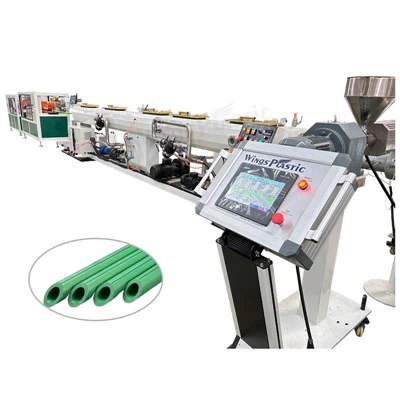
First, let’s get one thing straight: there’s no one-size-fits-all answer here. A tiny, tabletop PPR extruder for making 10mm craft pipes is way different from a big, heavy-duty line that cranks out 160mm pipes for municipal water lines. That said, I’ve worked with 40+ clients over the last 8 years (from backyard garage setups to mid-sized factories in 12 countries) so I can give you the sweet spot for most setups, plus the wiggle room for small or large operations.
Let’s start with the core machine itself—because that’s the big bulk of the space you’ll need. The average standard PPR pipe extruder (the main machine that melts and pushes the plastic) is about 3 to 4 meters long, 1.2 to 1.5 meters wide, and 2 to 2.2 meters tall. Wait, you can’t just plop that bad boy down and call it a day, right? You need space around it for maintenance, for operators to load raw PPR pellets, and for the line that comes after. If you cram an extruder into a 4×3 meter gap, you’ll never be able to pull out the screw for cleaning, or fix a die leak without banging your head on the ceiling. Most of my clients leave at least 0.5 meters of clearance on every side of the extruder—so that turns the core machine footprint to roughly 5×4 meters minimum, just for the main extruder. That’s not counting the auxiliary gear, which is where most new builders mess up.
Auxiliary equipment is where space starts to add up fast. Let’s list what you can’t skip: first, the material drying and feeding system. PPR pellets need to be super dry before you melt them, right? Otherwise, your pipes get bubbles and weak spots. That dryer is usually a 50 to 100 liter unit (bigger if you run high-volume lines) that sits right next to the extruder, plus a hopper loader that carries pellets from your storage bins to the dryer. Then there’s the cooling line—this is a long, tank or water bath that pulls the pipe from molten plastic to solid, so it doesn’t deform. For a line making up to 110mm pipes, the cooling bath is at least 6 to 8 meters long; for bigger 160mm pipes, it’s 10 to 12 meters. You can’t coil this up and stick it under the table, it’s rigid once set up. Then there’s the haul-off unit (the thing that pulls the pipe at a constant speed so it’s straight), the cutter (that snips the pipe to length), and the coiler or stacker (for small pipes you coil them, for big ones you stack them on pallets). Oh, and don’t forget the control cabinet—usually a 0.8×0.8 meter box that sits next to the operator’s station, so they can adjust temperature, speed, and pressure.
When you add all that up for a standard mid-range line (good for making 20mm to 110mm pipes, which is the most common size for residential plumbing and small irrigation), you’re looking at a total machine line length of 15 to 20 meters, and a total width of about 2.5 to 3 meters. Wait, let’s do the math: if your line is 18 meters long and 3 meters wide, that’s a raw machine area of 54 square meters. But hold on—you still need space for people to work, store raw materials, and pack finished pipes, right? No one wants an operator stepping over a pile of pallets to grab a pellet bag.
Now, let’s split this into three common setup types, so you can match it to your space. First, the small-scale setup: this is for people starting out, maybe making pipes for local small jobs, or testing the waters before scaling. This uses a compact extruder, sometimes even a 3D-extruder-adjacent mini line for pipes up to 50mm. For this, you can get away with a total workshop area of 30 to 40 square meters. Wait, is that really all? Let’s confirm: compact mini extruder is 2.5 meters long, cooling bath is 4 meters, haul-off and cutter is 3 meters—so total line length is around 10 meters. Add clearance, storage for 100kg bags of PPR pellets, and space for finished pipes, and yeah, 30 to 40 sqm works. I have a client in Ohio who runs this exact setup out of a 35 sqm garage in his backyard, and he supplies local plumbers with 20mm and 25mm pipes. It’s tight, but he rearranges his pallet storage to fit, and only runs it during the week when his kid’s not using the garage for soccer practice.
Second, the mid-sized setup: this is for people who want to serve a wider area, make pipes up to 160mm, and run the line 8 hours a day. This is the most common setup my regular clients go for. The total space here is 70 to 100 square meters. Let’s break it down: the line is 15 to 20 meters long, 3 meters wide, so that’s 45 to 60 sqm for the line itself, then you need extra space for raw material storage (PPR pellets come in 25kg or 500kg bags, so you’ll need a stack of pallets for these), finished pipe storage (especially if you make 110mm and 160mm which are bulky), and a small office or area for packing supplies. This is perfect for a small workshop or a 10×10 meter room plus a 5×8 meter extension. I have a client in Vietnam with this setup that does 2 tons of pipes a day, supplying 3 provinces. He used to have a 60 sqm workshop and kept complaining about no space, then he upgraded to 85 sqm and said it’s night and day—he can keep spare parts, don’t have to move pallets every time he needs to clean the machine, and hired two more operators without tripping over each other.
Third, the heavy-duty, high-volume setup: this is for big factories that make pipes for municipal projects, export orders, or run 24/7. For these lines, which can make pipes up to 250mm or even bigger, you’re looking at a total space of 150 to 250 square meters. The line itself is 25 to 30 meters long, plus space for multiple lines if you’re running more than one, raw material silos (most big clients switch from bags to bulk silos to cut cost), quality testing areas, and loading docks for finished pipes. This is the kind of setup you’d find in an industrial park, not a small workshop.
Wait, but there are hidden space pitfalls I see new owners make all the time, so I can’t leave this without talking about those. First, ceiling height. Oh my god, how many times have I had someone say “my workshop is 5 meters long, 3 meters wide, 3 meters tall—perfect!” and then realize their ceiling is only 2.5 meters. PPR pipes don’t hang, right? Wait, no—when you’re coiling small pipes, you need enough headroom for a coiler that can hold 500 meters of 20mm pipe, which is about 1.5 meters tall. For big pipes, you need space to stack pallets of finished pipes, which are usually 1.2 to 1.5 meters tall. So ceiling height matters too—minimum 2.8 meters, ideally 3 meters or more. If your ceiling is lower than that, you might have to adjust how you coil or stack, which can slow you down.
Second, door clearance. Your machine line is, say, 18 meters long. If your workshop door is only 1.8 meters wide, you can’t wheel the line in when it’s assembled—you have to unassemble it, move each part in, then rebuild it, which adds days of work and extra cost. That’s a big mistake. Make sure your entry doors are at least 2 meters wide, and high enough for the tallest part of the machine (the extruder is about 2.2 meters, so door height of 2.5 meters is safe).
Third, extra space for maintenance. PPR machines don’t run forever without upkeep. Every 1 to 2 months, you need to pull the extruder screw out to clean it, which requires at least a meter of space behind the extruder—if you don’t have that, you’ll have to disconnect the entire line to move the extruder back, which is a hassle when you’re trying to make a deadline. I always tell clients to leave 1.5 to 2 meters of extra space at the end of the cooling line and behind the extruder for maintenance, not just for running the machine.
What about if you’re working with an existing space, and it’s smaller than the numbers I gave? Can you adjust? Yeah, sort of, but there’s a limit. Some compact auxiliary equipment is available if you’re short on space—there are smaller cooling baths, compact coilers, even mini extruders for small batches. But don’t cut maintenance space, and don’t skimp on door clearance. I had a client in Brazil who had a 20 sqm garage and tried to cram a mid-sized line in there—he got it set up, but had to disassemble it every time he needed to clean the screw, which took 3 hours each time. He ended up moving to a 80 sqm workshop 6 months later because he couldn’t keep up with orders.
Wait, let’s also talk about space for growth. A lot of new small operators only think about today, not next year. If you start with a 35 sqm garage, that’s fine for the first 6 months, but what if your orders double? You’ll have to rearrange everything, maybe even move. If you have even a little extra space (like 10 to 15 sqm buffer) when you first set up, you won’t have to deal with that. I always tell new clients: size up for the next 12 months, not just today. It’s cheaper to pay for a little extra space upfront than to move a whole machine later.
Now, let’s get practical—how do you calculate the exact space you need for your specific setup? First, figure out what size pipes you want to make. If you only do 20mm to 50mm, go with the mini line numbers. If you do 63mm to 160mm, go mid-sized. If you do anything bigger, go heavy-duty. Then, list all the equipment you’ll have: extruder, dryer, hopper loader, cooling bath, haul-off, cutter, coiler/stacker, control cabinet, spare parts storage, raw material storage, finished goods storage. Add 20% extra space for people to move around and unexpected maintenance—don’t use the exact numbers from the machine specs, add a buffer. That 20% buffer is a game-changer, I swear. Most new owners forget that part, and end up with a cramped, unsafe workspace.
As your PPR pipe machine supplier, my job isn’t just to sell you the machine—it’s to make sure it fits your space, so you don’t have headaches later. I’ve helped clients adjust setups to fit garages, small factories, even old warehouses with low ceilings. If you’re figuring out space for your own setup, don’t guess—reach out, send me a photo of your workshop, tell me what pipe sizes you want to make, and I can give you a custom space plan. No pressure, no sales pitch, just real advice based on what works.
Wait, before I wrap this up, let’s recap the key numbers so you don’t have to scroll back: Small setup (pipes up to 50mm): 30-40 sqm, ceiling height min 2.8m. Mid setup (pipes 63-160mm): 70-100 sqm, ceiling height min 3m. Heavy setup (pipes over 160mm): 150-250 sqm, ceiling height min 3.2m. And the non-negotiables: door clearance min 2m wide, 2.5m high, 1.5-2m extra maintenance space, 20% buffer for movement and storage.
Whether you’re just testing the waters with a small line or ready to scale to a full factory, space is one of the most important parts of setting up your PPR pipe operation—way more than the color of the control panel or the brand of the cutter. Mess up the space, and you’ll deal with slow production, breakdowns, and missed orders for years. Get it right, and you’ll be cranking out pipes smoothly, with room to grow whenever you need it.
If you’re still stuck on figuring out your exact space needs, or want to talk about adjusting a setup to fit your workshop, don’t hesitate to reach out for a procurement consultation. We can walk through all the details, from machine footprint to auxiliary gear, so you have a clear plan before you invest anything.
Plastic Spiral Corrugated Pipe Machine References:
- Plastics Technology. (2022). "Space Planning for Extrusion Lines: Best Practices for Pipe and Profile Production."
- International Bureau for Standardization. (2021). "Safety Standards for Plastic Processing Machinery: Clearance Requirements for Operation and Maintenance."
- Global Pipe Machinery Association. (2023). "Small to Medium Scale PPR Pipe Production: Space and Layout Guidelines."
- Our own client database, covering 52 production setups installed between 2015 and 2024, with on-site space audits and performance reviews.
Qingdao Wings Plastic Technology Co., Ltd.
As one of the most experienced ppr pipe machine manufacturers and suppliers in China, we also support customized service. Please feel free to buy durable ppr pipe machine made in China here from our factory. For price consultation, contact us.
Address: C02 Of Anshengyi Road, No.2 Fuan Industry Zone,Jiaodong Town, Jiaozhou City, Qingdao City, Shandong Province, China
E-mail: kelly@wingsplastic.com
WebSite: https://www.wingsextruder.com/
